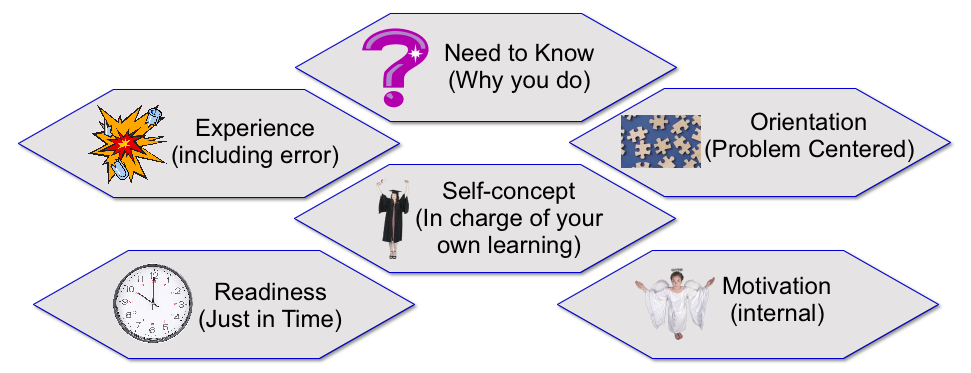
Our class has explored the characteristics of adult learning using Malcolm Knowle's six attributes. They are the following: 1. Need to Know, 2. Self- Concept, 3. Experience, 4. Readiness to Learn, 5. Orientation to Learn and 6. Motivation to Learn.
When I look at the accumulated attributes, I think they can be summed up by looking at the multitude of Dummies books. This is the link to the website: Dummies Books. I like the analogy the books make to adult learning because each book focuses on exactly what the learner wants and needs to know about each subject. Within each book, there are specific chapters that explain portions of the subject needed. There is not a lot of extraneous material. to dig through. If you want to know the basics of a subject, you can get that by reading a book. Below is an image of the types of books the company offers.
The company has targeted adults with these books because adults need to know what they are learning and they need to participate in the learning process. They also are motivated internally and they use the experience and knowledge they already have to help them learn. Adults want to learn a specific subject for a specific reason. For example, if they are going on a trip, they may want to learn the language in the country they are visiting. They will use the knowledge in a certain way.
Monday, April 29, 2013
Tuesday, March 5, 2013
Need to Know and More
This week, the class looked at the "Need to Know" attribute of adult learning. Need to know is the idea that adults need to know why they are learning something. They need to know how they will learn, what they will learn and what they will gain by learning. This is a brief idea of what Knowles meant by the phrase Need to Know.
"People become ready to learn something when they experience a need to learn it in order to cope more satisfyingly with real-life tasks and problems. The educator has a responsibility to create conditions and provide tools and procedures for helping learners discover their "needs to know." Learning programs should be organized around life-application categories and sequenced according to the learners' readiness to learn."
Taken from the weblink: http://teachinglearningresources.pbworks.com/w/page/30310516/Andragogy--Adult%20Learning%20Theory
"People become ready to learn something when they experience a need to learn it in order to cope more satisfyingly with real-life tasks and problems. The educator has a responsibility to create conditions and provide tools and procedures for helping learners discover their "needs to know." Learning programs should be organized around life-application categories and sequenced according to the learners' readiness to learn."
Taken from the weblink: http://teachinglearningresources.pbworks.com/w/page/30310516/Andragogy--Adult%20Learning%20Theory
Now it's on to Experience.
Tuesday, February 26, 2013
Self Concept Attribute
The self-concept of adult education is the same as an individual's self-concept. Self-concept revolves around the person. One can use the pronoun I liberally. I am responsible for how I learn. I will decide what I will learn. I am the person directing the process of my learning. The attribute of self is presented in this wiki.
Each week that we research and present our own version of an attribute expands what we are learning in new directions. I expect self concept to be no different.
This is my concept map of self-concept.
Tuesday, February 12, 2013
What a Constructivist

This week in working toward our project's completion we have explored a lesson in constructivism. Our group members are learning by doing. I found out how to remove unnecessary html code so that the blog page worked better, I figured out ways to edit after posting and I have gained more confidence in using Blogger, even though I have used it for several semesters. As with all these applications of technology, there is a pretty big learning curve after you figure out the basics. I am sure most members of this class have similar experiences.
We will post our exhibit as a blog page later this afternoon. This is the link.
Adult Learning Project
Please let us know what worked and what didn't with your comments. That's one of the best things about getting feedback, people see with fresh eyes.
Looking forward to all the other projects.
Tuesday, February 5, 2013
Second Adult Education Class
The project is about the roots of Pedagogy and how it relates to Andragogy. Pedagogy refers to children and Andragogy refers to adults. While there are similarities, there are many differences when dealing with the teaching of children and adults.
Pedagogy:
www.neiu.edu/~dbehrlic/hrd408/glossary.htm

Andragogy: Instructional theory by Malcolm S. Knowles dealing with the psychology and special needs of adult learners.
glossary.plasmalink.com/glossary.html
If you think about it, we move very quickly from childhood to adulthood. How we prefer to learn must change as rapidly as we grow. I have much to learn!
Tuesday, January 29, 2013
Adult Learning
This post is about the first class of Adult Learning. We held the first class in the F wing in Classroom 210. The class is a mixture of new and old MAIT students. There is a learning curve in the online approach so it is always interesting to see how people learn.
This is a link to my adult learning website from a few semesters ago. We were studying theorists and I was assigned to the group that was to create a lesson based on the principles of adult learning. The website has resources and other materials.
The six principles of Andragogy are in the graphic below.
Since we are working on adult learning, and using the on-line format, I am going to enhance what I am studying with a course taught in Coursera. The course is taught by a teacher at Georgia Tech, Fatimah Wirth and is a free six week online course, Fundamentals of Online Education: Planning and Application.
This is the link to the Coursera website:
There are a number of courses that work well with the MAIT program.
Monday, March 26, 2012
Today is our last class
This has been the warmest winter and March that I can remember. My daffodils already came out and have started to die off. All of my trees have budded. And I don't think any of the Chinese stinkbugs died off... We should be innundated with them by May. Oh, and I bought a new bird feeder for my backyard. I am using some new food and there are birds out here that I have never seen before. While I enjoy what technology brings to us in terms of accessibility, portability, information,etc., I still like to take time to enjoy things the old-fashioned way. Take time to smell the flowers.
Now for the school and technology part. I have completed my personal learning theory paper and submitted it. Hooray!! It's good to get it done. I am still completing some of my work for the theory class. I will somehow get everything done in a few days. I will also post the adult learning theory quiz results with the correct answers in the discussion area for anyone who is interested. I am still working on the Google sites portfolio. It takes me a while to find what I like. I have looked at others and it leaves me feeling inadequate. I don't feel I have that artistic side, but I am organized.
Thanks to all who have participated in the survey on technology in South Jersey schools. I have had a good response so far and anticipate that more people will take the survey. If you missed it before, this is the link Tech Survey I will send out the results to any one interested on the MAIT page.
Saturday, March 24, 2012
INTC 5110 Presentation Class: March 19, 2012
Jane, Colleen and I presented our lesson utilizing Adult Learning Theory. We worked together on the project without ever meeting face-to-face. We touched base at least once a week through Wimba and Skype. On the day of the presentation, I went to Southern Regional High School to meet Colleen and Jane for the first time. Jane and Colleen are two great ladies and I was glad to meet them in the real world. The school is beautiful and the people in the class are very warm and inviting. The presentation went pretty well. We had some technical glitches which we never had any of the times that we practiced our presentation previously. Colleen and Jane were able to clear up the problems as I started the first part of the project. All in all, things went well and it is a relief to complete our work for class!
Our project was about Adult Learning Theory. We created a lesson on using portfolios taught with adult learning theory. This is the link to the portfolio we used to collect and access all of the information we used during our presentation. ALT presentation site
I relate a lot to this theory. It offers many of the same ideas that I have used when working with adults as a manager. I did not know that I used any learning theory when I worked with my associates, but in retrospect, I was a big proponent of the concepts used in Knowles’ Adult Learning Theory. I have listed some of my ideas and how they relate to Knowles’ theory.
- · Everybody in an organization has a niche, in that they are good and like some work responsibilities, really good-at and love others and not so good-at and don’t like others. This relates to how experience plays a role in ALT.
- · People have diverse backgrounds, different cultures, different ideas, all of which have value, and should be respected. This relates to how adults require respect for their ideas and self-identity.
- · You can’t do everything yourself, so delegate to the associates who work for you; explain what you want and need, then let them do the work, checking on them occasionally to allow for questions and fine-tuning. This refers to self-direction and autonomy.
- · Give your associates guidelines that allow them the flexibility to make a decision and then support that decision. This also refers to autonomy in adult learning.
- · When explaining what tasks and projects need to be done, explain how completing the tasks will make things easier, more efficient or produce more income for the associate. This refers to the practical nature of adult learning.
- · Be patient when working with employees. This again refers to respect. Everyone learns differently.
Monday, March 5, 2012
Today’s class saw the first three of the seven learning theory projects we will study in this class. The first of the three presentations was on Synectics, which are teaching approaches that use metaphors and analogy to increase the understanding of students about a specific topic or issue. To me the most important aspect of Synectics is the use of making the familiar strange and the strange familiar. The learner is encouraged to think outside the box. Synectics is similar to brainstorming in teams. One of the results of using Synectics in groups is that the ideas that others discover can trigger new ideas for other members in the group.
![]() |
| Skinner Box |
The next presentation was on Behaviorism. B. F. Skinner and his famous experiments were examined. We also looked at some of Pavlov’s work and related it to Behaviorism Theory. Since I attended Catholic school as a child, I think I have experienced behaviorism in action.
Pavlov's dog experiments are staples in psychology and now I have a better understanding of how they relate to behaviorism. These theories all relate to one another in their various ways.
![]() |
| Pavlov's Dog |
We had a lesson that used behaviorism as the learning method. While some aspects of Behaviorism work well, I don’t think it is a good approach for all learning; especially higher level learning.
![]() |
| Cognitivism uses the brain |
We ended the night knowing that we have many methods to utilize in our training and teaching methods.
Next week will provide even more theories to incorporate.
Monday, February 13, 2012
INTC 5110 Class Three February 7, 2012
In today’s class we had an opportunity to experience education in an online, totally virtual environment. The class logged on from many different locations including the Caribbean.
Our teacher, Sue logged in from her location about a thousand miles away. The rest of the class logged in from home and school from South Jersey. It just shows that with online learning, distance really doesn’t matter. One thing we learned with this experience is that there is a learning curve using technology; preparation is the key! My group plans to work through any problems with several practice sessions on Wimba before the actual presentation is due. Tonight’s class is presenting three projects on learning theory. Each group is presenting a different theory. I look forward to seeing how each group approaches the project.
See you in class tonight!
Monday, February 6, 2012
INTC 5110 Class Two January 30, 2012
We are moving along quickly. This class let us explore the research resources of Stockton Library. There is a link to some instructional videos on the library's home page. This is a link to the Stockton Library Home Page. Stockton Library
The two most important research search engines are: Summon and Ebscohost. There are numerous databases which can be searched by subject and ways to drill down the information you find to the information you need. If you are unable to locate a needed resource, you can usually obtain it through the inter-library services option. If all else fails, ask one of the helpful and knowledgeable librarians.
I am using the library to research my personal learning theory topic. I am looking at how training employees can be improved using adult learning theory. I am gathering ideas so if anyone has info relating to this topic, please post a comment. See you in class.
Wednesday, February 1, 2012
INTC 5110 Class One January 23, 2012
The first class of INTC 5150 Learning Strategies for Instructional Technology took place on Monday night, January 23. Many in the class attended virtually through Wimba. Wimba works well once you understand the way it works; sometimes it can be a bit of a work in process. One is able to participate virtually or in person, which is a real benefit when the class is a distance from where you are. Using Wimba to attend class saves time, money and travelling.
The class is producing projects exploring the seven following learning theories: Behavioral Theory, Cognitive Theory, Constructivism, Synetics Theory, Humanist/ARCS Theory, Connectivism, and Adult Learning. Each project will present a specific theory researched by a team of students from both classes. These seven theories are the basis for the design of educational instruction.
I am working with two people from the other INTC 5150 class, Jane Constantino and Colleen Murray. We will be collaborating on Adult Learning Theory. We first met in the virtual Wimba class and held our first group meeting on Skype.
Adult Learning Theory explains how adults approach learning differently from children. It is a useful theory to have when working at the college and corporate levels. One of the key points of Adult Learning Theory is that adults bring a different perspective to learning because they have more experiences than children do. This is a link to a concise explanation of adult learning theory.
Principles of adult learning
Wednesday, December 14, 2011
End of Semester Reflections
This has been a challenging semester. I had surgery on my eye, was in the hospital two weeks later and my daughter went in a few weeks after that. In addition, I was working two part-time jobs and taking two courses. It is a lot to juggle but I know it's worth it. I'm looking forward to the relative calm of the holidays.


I used a movie-maker program called xtranormal for my simulated interview. It turned out really well. The only problem I had was that I wanted to use a French accented speaking voice but the ones available were too difficult to understand. The program is free up to a point, then you need to buy time so you can publish your movie.
This is the link: xtranormal
This is the link to the project I created in xtranormal: Jean Piaget Interview
Another neat tool is Animoto. I created a short movie about my mom's eightieth birthday. Animoto allows you to use up to twelve photos for a thirty second video. For longer movies, you need to buy a monthly subscription. I believe it's $5/ month. You can use your own music or theirs. They provide formats for your video. Some need the upgrade to use. I used their original format and it came out great.
The Animoto link is here: Animoto
My movie link is here. Mom's Eightieth B'day
For all the MAIT program students; don't forget to check out the MAIT facebook page. It has lots of information on classes you are taking now plus classes you will be taking in the future. The college is trying to set up a theory class in Egg Harbor City for the Spring. I know a number of people are interested, so if you would like to take that course, talk to Amy, or check the MAIT facebook page
The MAIT facebook page: facebook.com/stockton-MAIT
University · Galloway, New Jersey
Friday, December 2, 2011
Last Week of the Semester
Friday, December 02, 2011
Last Face-to-Face Class
This is the last class for Introduction to Instructional Technology. It has been an engaging semester and everyone has learned a lot. We began the semester with some trepidation but overcame it as our confidence increased. This class also introduced us to some of the key players in instructional technology along with an introduction to some learning theories. The next few courses will focus more on these two topics. My classmates in this course have inspired me to look at new ways to present information. I especially want to work with Movie Maker and other movie creation programs. This is a project I plan to work on over the semester break.
ADDIEOne of the learning theories we recently discussed was the ADDIE model.
The name ADDIE stands for the words:
Analysis- Analysis looks at the goals, objectives, needs and all other information pertinent to solving the problem.
Design-Design is the process used to work with the learning objectives. One can use storyboards and other planning methods to create how the learning presentation will look and feel.
Development-Development is producing a product with the materials and methods generated during the design process.
Implementation-Implementation puts the plan into action and begins the process of training/teaching.
Evaluation-Evaluation is the final phase of the ADDIE process. This phase is broken into two parts where the first part is evaluating each of the participants’ progress and the second learning how effective the instructional materials were.
Here are two links that summarize the ADDIE model.
Thursday, December 1, 2011
Last Face to Face Class in Intro to IT
Thursday, December 01, 2011
Last Face-to-Face Class
This is the last face-to-face class for Introduction to Instructional Technology. It has been an engaging semester and everyone has learned a lot. We began the semester with some trepidation but overcame it as our confidence increased. This class also introduced us to some of the key players in instructional technology along with an introduction to some learning theories. The next few courses will focus more on these two topics. My classmates in this course have inspired me to look at new ways to present information. I especially want to work with Movie Maker and other movie creation programs. This is a project I plan to work on over the semester break.
ADDIE
One of the learning theories we recently discussed was the ADDIE model.
The name ADDIE stands for the words:
Analysis- Analysis looks at the goals, objectives, needs and all other information pertinent to solving the problem.
Design-Design is the process used to work with the learning objectives. One can use storyboards and other planning methods to create how the learning presentation will look and feel.
Development-Development is producing a product with the materials and methods generated during the design process.
Implementation-Implementation puts the plan into action and begins the process of training/teaching.
Evaluation-Evaluation is the final phase of the ADDIE process. This phase is broken into two parts where the first part is evaluating each of the participants’ progress and the second learning how effective the instructional materials were.
Here are two links that summarize the ADDIE model.
http://www.learning-theories.com/addie-model.html
http://fog.ccsf.cc.ca.us/~mmalacho/OnLine/ADDIE.html#E
Wednesday, November 30, 2011
Happy Belated Thanksgiving
Wednesday, November 30, 2011
IVLA
When reviewing the presentations from the IVLA conference, I was again impressed by the quality and variation. People were able to learn from presentations created by people from Korea, Australia and Brazil among other places. We do not often get to visit other countries so learning what is important to the people in those countries adds a layer to their presentations. The topics at the conference covered everything from photography to pollution, chemistry to web site development. It would be difficult not to find a reason to attend. My best understanding is that the next IVLA conference (2012) will be held in Maine. I plan to attend if there is any possible way.
MAIT Showcase
MAIT Showcase
Another event that is well worth the time to attend is the MAIT Showcase. The showcase presents the capstone projects of graduating MAIT students. The capstone pulls together information learned in previous classes along with the tools and resources needed to solve a problem you have observed. The problem should be solvable and the resolution presented should incorporate technologies learned taking previous courses. The capstone course, INTC 5810 Capstone: Final Project, is the last course taken in order to complete the work for the MAIT degree. The course is taken in the last semester of education and is a lot of work. This year’s showcase is being held in the new Student Center on Monday, December 5 from 6: 00 to 8: 00 PM. For those of us who are in the process of completing our degree, it will be an eye-opening evening. Although I’m not sure, there is usually food as well.
Facebook
When you have a moment, log on to facebook to look at our MAIT page. It has information about the different courses in the MAIT program, what to expect in individual courses and current events that could be have interest. This is the link. MAIT on Facebook You are required to log in when you make a comment.
Wednesday, October 12, 2011
Wednesday, October 5, 2011
I attended this class through Wimba. The class looked at how to access the research material in the Stockton library. There are links to tutorials that will help you understand the process to obtain the research articles. The tutorials offer some great insights about how to work efficiently and give you information you will appreciate. Having a way to get the APA formatting for a document is my favorite. It is so much easier than trying to do it yourself. Just remember to double check the formatting since it does not always format correctly. The tutorials are set up so that you can watch them on video or read the information.

The library link is: Library
This is a list of the tutorials and what is most important about each.
Video Tutorial 1: Education Research Complete
o Automatically format the citation into APA
o Limit search results to no more than 50; 35 is preferable
o Ability to limit search results to peer reviewed papers
o Ability to forward research via email with the APA citation
Video Tutorial 2: Preserving your results
o Seems to be a review of the first video in that it reviews emailing the results with APA formatting
o Ability to save to a folder during the research session
Video Tutorial 3: ILLiad registration
o Illiad provides the ability to obtain resources from other libraries
o Ten day window before arrival
o Requires registration with Stockton Z#
Video Tutorial 4: Submitting a request
o Check Stockton’s library for the needed resource before following the ILLiad steps above (Stockton cannot have the required resource available)
Video Tutorial 5: Peer reviewed Articles
o Articles are more difficult to submit and get approval for journals, therefore the implication is a higher level of validity
o Check the peer reviewed check box to limit your search to these resources
The class also looked at the first IT Timeline presented by Robynn. She did an excellent job and has set the standard at a very high level. Way to go, Robynn!
Wednesday, October 5, 2011
Wednesday, September 28, 2011
Today’s class was cancelled due to the IVLA Conference. This was an opportunity to catch up on some of the work I need to complete. I did catch up a little bit but have a way to go.
More importantly, I attended the IVLA Conference on Friday. The website address for the IVLA conference is: http://www.ivla2011.org/index.cfm.
The Seaview, where the conference was held is aptly named. It has a beautiful view of the sea; hence the name. This is the website address: http://www.dolce-seaview-hotel.com/.

The Seaview Resort and Spa
The conference was excellent and offered a chance to hear people from all over the country and some international people. The presenters spoke about the work they were doing in visual literacy. They used various media to show their work and answered questions both during and after their presentations. The atmosphere was casual and unimposing. Observers were able to comment and ask questions.
The key note speaker on Friday was Wendel White. He presented his work: Hidden in Plain Sight: African American Artifacts and Architecture in the American Landscape.
The presentation looked at photographs of African American artifacts, some taken in South Jersey a short distance away from the conference. The images that impacted me the most were of the segregated schools throughout the country. The images showed the school in its original location. The area around the school was made gray so that the school becomes the highlight of the image. Mr. White uses the images to speak about segregation in northern states. I don’t usually think of segregation occurring in this part of the country as much as the South but you can’t deny that it was a definite part of our cultural history. Segregation continues to exist in some form today. This is a link to Mr. White’s website: http://wendelwhite.com/. I have included one of the photos presented by Mr. White at the conference. The school building is highlighted while the background is faded. The image below is of a school in Whitesboro, NJ.

Another presentation I enjoyed was: Shape and the Placing of Visual Literacy: The Case of Shelby Lee Adams’ Appalachian Photography. This was presented by Jennifer Mooney from Virginia Tech. Shelby Lee Adams photographs subjects from the Appalachian region of the country. He seems to pick subjects that evoke negative reactions especially from people who are native to the region. Ms. Mooney used Face Book to gauge the reactions of people from different parts of the country to different photos of Appalachia. Photographers included: Shelby Lee Adams, Walker Evans, Dorothea Lange, Earl Dotter and Wendy Ewald. Overall Adams’ photographs evoked the most negative reactions from all participants but most especially from Appalachian natives. The interesting thing about attending a conference in person is you get to speak directly to the presenter and interact with them. Ms Mooney encouraged people to contact her. She sent me a copy of her presentation as well.
I hope to be able to use some of the ideas explored in the presentations as I learn about visual literacy.
More importantly, I attended the IVLA Conference on Friday. The website address for the IVLA conference is: http://www.ivla2011.org/index.cfm.
The Seaview, where the conference was held is aptly named. It has a beautiful view of the sea; hence the name. This is the website address: http://www.dolce-seaview-hotel.com/.
The Seaview Resort and Spa
The conference was excellent and offered a chance to hear people from all over the country and some international people. The presenters spoke about the work they were doing in visual literacy. They used various media to show their work and answered questions both during and after their presentations. The atmosphere was casual and unimposing. Observers were able to comment and ask questions.
The key note speaker on Friday was Wendel White. He presented his work: Hidden in Plain Sight: African American Artifacts and Architecture in the American Landscape.
The presentation looked at photographs of African American artifacts, some taken in South Jersey a short distance away from the conference. The images that impacted me the most were of the segregated schools throughout the country. The images showed the school in its original location. The area around the school was made gray so that the school becomes the highlight of the image. Mr. White uses the images to speak about segregation in northern states. I don’t usually think of segregation occurring in this part of the country as much as the South but you can’t deny that it was a definite part of our cultural history. Segregation continues to exist in some form today. This is a link to Mr. White’s website: http://wendelwhite.com/. I have included one of the photos presented by Mr. White at the conference. The school building is highlighted while the background is faded. The image below is of a school in Whitesboro, NJ.
Another presentation I enjoyed was: Shape and the Placing of Visual Literacy: The Case of Shelby Lee Adams’ Appalachian Photography. This was presented by Jennifer Mooney from Virginia Tech. Shelby Lee Adams photographs subjects from the Appalachian region of the country. He seems to pick subjects that evoke negative reactions especially from people who are native to the region. Ms. Mooney used Face Book to gauge the reactions of people from different parts of the country to different photos of Appalachia. Photographers included: Shelby Lee Adams, Walker Evans, Dorothea Lange, Earl Dotter and Wendy Ewald. Overall Adams’ photographs evoked the most negative reactions from all participants but most especially from Appalachian natives. The interesting thing about attending a conference in person is you get to speak directly to the presenter and interact with them. Ms Mooney encouraged people to contact her. She sent me a copy of her presentation as well.
I hope to be able to use some of the ideas explored in the presentations as I learn about visual literacy.
Subscribe to:
Posts (Atom)