Tuesday, February 26, 2013

Self Concept Attribute


The self-concept of adult education is the same as an individual's self-concept. Self-concept revolves around the person. One can use the pronoun I liberally. I am responsible for how I learn. I will decide what I will learn. I am the person directing the process of my learning. The attribute of self is presented in this wiki.

Each week that we research and present our own version of an attribute expands what we are learning in new directions. I expect self concept to be no different.

This is my concept map of self-concept.


Tuesday, February 12, 2013

What a Constructivist


This week in working toward our project's completion we have explored a lesson in constructivism. Our group members are learning by doing. I found out how to remove unnecessary html code so that the blog page worked better, I figured out ways to edit after posting and I have gained more confidence in using Blogger, even though I have used it for several semesters. As with all these applications of technology, there is a pretty big learning curve after you figure out the basics. I am sure most members of this class have similar experiences.

We will post our exhibit as a blog page later this afternoon. This is the link.
Adult Learning Project

Please let us know what worked and what didn't with your comments. That's one of the best things about getting feedback, people see with fresh eyes.

Looking forward to all the other projects.

Tuesday, February 5, 2013

Second Adult Education Class


We have completed our second class in Adult Education and have been assigned a group project. I am working with two classmates who both live a distance away from school and each of us. We have decided to use Google Drive. It was formerly called Google Docs. Google Drive allows everyone on the project to add and edit information that the group will use. The completed product will really be a group effort with contributions from each of us. This online component works out very well when trying to meet together in person is so difficult. 
The project is  about the roots of Pedagogy and how it relates to Andragogy. Pedagogy refers to children and Andragogy refers to adults. While there are similarities, there are many differences when dealing with the teaching of children and adults. 
Pedagogy:

Literally means the art and science of educating children, pedagogy is often used as a synonym for teaching. Pedagogy embodies teacher-focused education.

                www.neiu.edu/~dbehrlic/hrd408/glossary.htm

 
Andragogy: Instructional theory by Malcolm S. Knowles dealing with the psychology and special needs of        adult learners.
glossary.plasmalink.com/glossary.html

If you think about it, we move very quickly from childhood to adulthood. How we prefer to learn must change as rapidly as we grow. I have much to learn!


Tuesday, January 29, 2013

Adult Learning


This post is about the first class of Adult Learning.  We held the first class in the F wing in Classroom 210. The class is a mixture of new and old MAIT students. There is a learning curve in the online approach so it is always interesting to see how people learn.

This is a link to my adult learning website from a few semesters ago. We were studying theorists and I was assigned to the group that was to create a lesson based on the principles of adult learning. The website has resources and other materials.


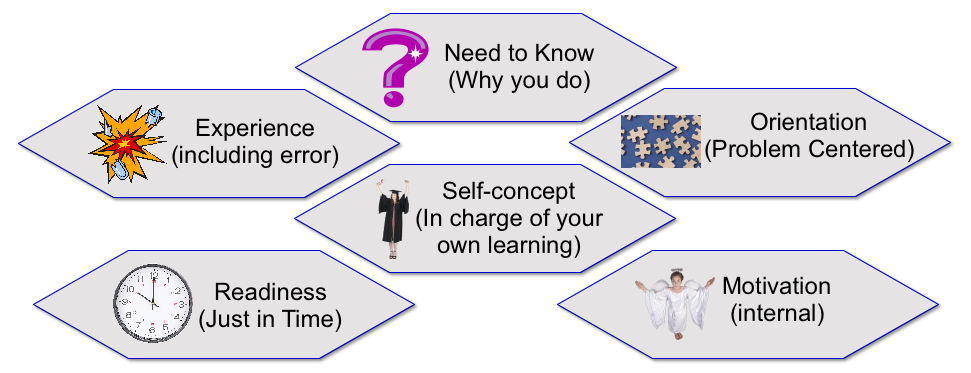
The six principles of Andragogy are in the graphic below.


Since we are working on adult learning, and using the on-line format, I am going to enhance what I am studying with a course taught in Coursera. The course is taught by a teacher at Georgia Tech, Fatimah Wirth and is a free six week online course, Fundamentals of Online Education: Planning and Application.

This is the link to the Coursera website:


There are a number of courses that work well with the MAIT program.


Monday, March 26, 2012

Today is our last class

 Since today is our last class I thought I would include some thoughts about things other than technology  and education. For one thing, my orchid is back. I only water it about every 10 days and hadn't noticed that it was about to bloom. I really can't take credit for such a lovely event.

This has been the warmest winter and March that I can remember. My daffodils already came out and have started to die off. All of my trees have budded. And I don't think any of the Chinese stinkbugs died off... We should be innundated with them by May. Oh, and I bought a new bird feeder for my backyard. I am using some new food and there are birds out here that I have never seen before.  While I enjoy what technology brings to us in terms of accessibility, portability, information,etc., I still like to take time to enjoy things the old-fashioned way. Take time to smell the flowers.

Now for the school and technology part. I have completed my personal learning theory paper and submitted it. Hooray!! It's good to get it done. I am still completing some of my work for the theory class. I will somehow get everything done in a few days. I will also post the adult learning theory quiz results with the correct answers in the discussion area for anyone who is interested. I am still working on the Google sites portfolio. It takes me a while to find what I like. I have looked at others and it leaves me feeling inadequate. I don't feel I have that artistic side, but I am organized.

Thanks to all who have participated in the survey on technology in South Jersey schools. I have had a good response so far and anticipate that more people will take the survey. If you missed it before, this is the link Tech Survey I will send out the results to any one interested on the MAIT page.
Posted by Picasa

Saturday, March 24, 2012

INTC 5110 Presentation Class: March 19, 2012

 
          Jane, Colleen and I presented our lesson utilizing Adult Learning Theory. We worked together on the project without ever meeting face-to-face. We touched base at least once a week through Wimba and Skype. On the day of the presentation, I went to Southern Regional High School to meet Colleen and Jane for the first time. Jane and Colleen are two great ladies and I was glad to meet them in the real world. The school is beautiful and the people in the class are very warm and inviting. The presentation went pretty well. We had some technical glitches which we never had any of the times that we practiced our presentation previously.  Colleen and Jane were able to clear up the problems as I started the first part of the project.  All in all, things went well and it is a relief to complete our work for class!

          Our project was about Adult Learning Theory. We created a lesson on using portfolios taught with adult learning theory. This is the link to the portfolio we used to collect and access all of the information we used during our presentation. ALT presentation site 

          I relate a lot to this theory. It offers many of the same ideas that I have used when working with adults as a manager. I did not know that I used any learning theory when I worked with my associates, but in retrospect, I was a big proponent of the concepts used in Knowles’ Adult Learning Theory. I have listed some of my ideas and how they relate to Knowles’ theory.

  • ·         Everybody in an organization has a niche, in that they are good and like some work responsibilities, really good-at and love others and not so good-at and don’t like others. This relates to how experience plays a role in ALT.
  • ·         People have diverse backgrounds, different cultures, different ideas, all of which have value, and should be respected. This relates to how adults require respect for their ideas and self-identity.
  • ·         You can’t do everything yourself, so delegate to the associates who work for you; explain what you want and need, then let them do the work, checking on them occasionally to allow for questions and fine-tuning.  This refers to self-direction and autonomy.
  • ·         Give your associates guidelines that allow them the flexibility to make a decision and then support that decision. This also refers to autonomy in adult learning.
  • ·          When explaining what tasks and projects need to be done, explain how completing the tasks will make things easier, more efficient or produce more income for the associate.  This refers to the practical nature of adult learning.
  • ·         Be patient when working with employees. This again refers to respect. Everyone learns differently.
                These are some of the ideas I have used when coaching and training my staff. A lot of the thoughts I had about how to work with people were similar to how Knowles viewed teaching adults. I shared our graphic map above.


Monday, March 5, 2012

INTC 5110 Class Four February 14, 2012
Today’s class saw the first three of the seven learning theory projects we will study in this class. The first of the three presentations was on Synectics, which are teaching approaches that use metaphors and analogy to increase the understanding of students about a specific topic or issue. To me the most important aspect of Synectics is the use of making the familiar strange and the strange familiar. The learner is encouraged to think outside the box. Synectics is similar to brainstorming in teams. One of the results of using Synectics in groups is that the ideas that others discover can trigger new ideas for other members in the group.
Skinner Box
The next presentation was on Behaviorism.  B. F. Skinner and his famous experiments were examined. We also looked at some of Pavlov’s work and related it to Behaviorism Theory. Since I attended Catholic school as a child, I think I have experienced behaviorism in action. 
Pavlov's dog experiments are staples in psychology and now I have a better understanding of how they relate to behaviorism. These theories all relate to one another in their various ways.


Pavlov's Dog

We had a lesson that used behaviorism as the learning method. While some aspects of Behaviorism work well, I don’t think it is a good approach for all learning; especially higher level learning.
Cognitivism uses the brain


The final lesson was on cognitivism. Cognitive theory uses the scientific method, and measurable means to approach and define learning. The focus is on the brain and how it is able to learn.
We ended the night knowing that we have many methods to utilize in our training and teaching methods.

Next week will provide even more theories to incorporate.